Berlin's flat topography means that man-made heights dominate the cityscape. The Fernsehturm (TV Tower) at 368 meters — built by the East German government in 1969 as a statement of socialist modernity — remains the tallest structure in Germany and the defining vertical element of the Berlin skyline. The tower's revolving restaurant and observation deck provide the most complete 360-degree Berlin panorama available anywhere: West Berlin to the right with the Tiergarten and the Ku'damm, East Berlin below with the Alexanderplatz grid and the Karl-Marx-Allee boulevard, and the forested Spreewald in the far distance.
The Reichstag dome — Norman Foster's luminous glass structure added to the restored 19th-century parliament building in 1999 — provides a free, bookable panoramic view that is one of Berlin's most popular. The interior double helix ramp inside the glass dome offers views both outward over the Tiergarten, the government quarter, and the Brandenburg Gate, and inward down into the parliamentary chamber below. The rooftop terrace of the Reichstag accessible from the dome walk is the only position in Berlin that combines the Brandenburg Gate view with the city's western panorama simultaneously.
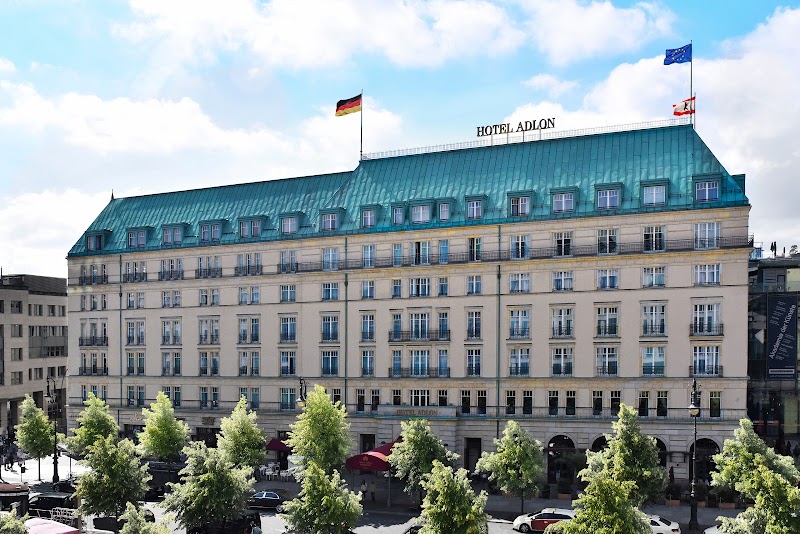
The Mitte area hotels benefit from proximity to the most historically dense part of the Berlin skyline — the Brandenburg Gate, the Gendarmenmarkt's twin French and German cathedrals flanking the concert hall, the Berliner Dom (cathedral) on Museum Island, and the Palace of Tears at Friedrichstraße all concentrate within walking distance. Hotels with upper-floor rooms in this zone look across a 19th-century European city skyline that survived WWII's worst damage and was later restored in ways that make the historic core feel remarkably complete.
The Tiergarten — Berlin's 210-hectare central park, at the heart of the city between the Ku'damm shopping district and the government quarter — provides one of the city's most beautiful ground-level views. The park was completely replanted after the war, when Berliners chopped down every surviving tree for firewood in the bitter winter of 1946–47, and the mature chestnut and lime trees now form a canopy that shelters the Victory Column (Siegessäule) at the center. Hotels at the Tiergarten's eastern edge in Mitte have park-facing rooms with views into this green depth.
Berlin's Kreuzberg district, straddling the former Wall corridor, has a unique relationship with views and history. The Viktoriapark on the Kreuzberg hill (its name means 'cross mountain') provides the highest natural point in inner Berlin, with views north across the flat city toward the Fernsehturm and south toward the Tempelhof field. Hotels near Mehringdamm and the Bergmannstraße area have partial Viktoriapark views and easy access to the hilltop for wider city panoramas.