Sleep Somewhere Extraordinary — 20 Unique Hotels You Won't Forget
Some hotels are good. Some are excellent. And then there are hotels where the accommodation itself — its architecture, setting, or concept — is the entire point of the journey. These 20 properties offer experiences so singular that guests book them years in advance, return repeatedly, and describe them for the rest of their lives.
When the Hotel Is the Destination
Most travel involves visiting a place and finding a hotel. These 20 properties invert that logic: they are the destination, with everything else — the surrounding city, country, or landscape — serving as supporting context. The experience of staying in them is the reason to book.
They range from a capsule hotel on the floor of the ocean to a treehouse in a Swedish forest, from an ice hotel rebuilt every winter in Lapland to a cave suite carved from 2,000-year-old volcanic rock in Santorini. What they share is irreplaceability: no other hotel anywhere offers anything quite like them.
Overwater Bungalows: The Category That Changed Hotel Design
Bora Bora Pearl Beach Resort — French Polynesia
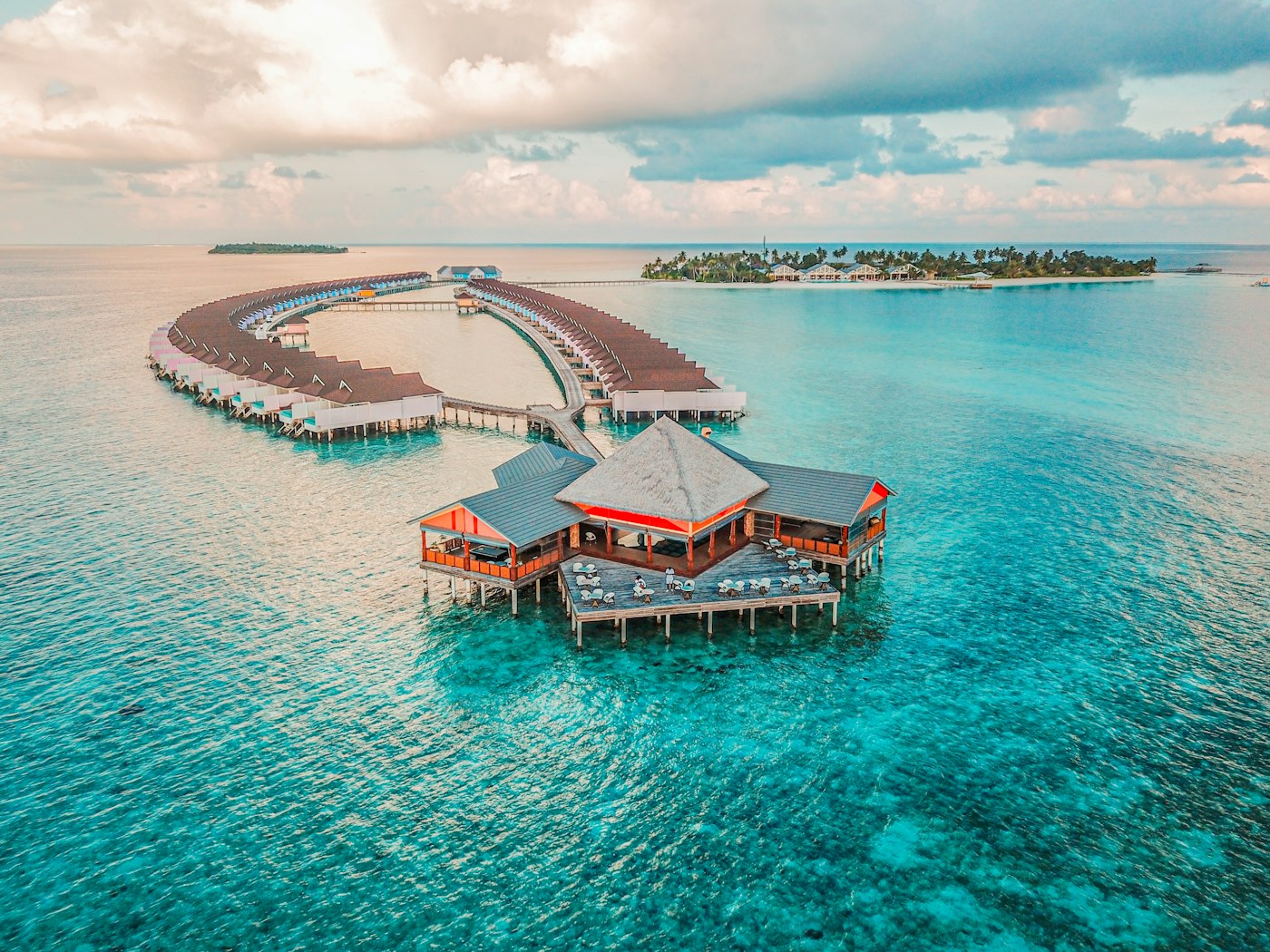
The overwater bungalow was invented in Bora Bora in 1967, and the concept has never been bettered in its place of origin. The glass floor panels in each bungalow allow you to watch the reef fish directly below your room; the ladder into the lagoon is one of hotel travel's iconic experiences. Book Pearl Beach Resort Bora Bora.
Gili Lankanfushi — Maldives
The world's largest overwater villas are in the Maldives at Gili Lankanfushi — the Private Reserve villa covers 1,600 square metres, with its own pool, slide, and private jetty. But even the entry-level overwater bungalows here are superlative: no shoes policy throughout the resort, butler service by boat, and some of the Maldives' clearest lagoon water. Reserve Gili Lankanfushi.
Treehouse Hotels: Elevated Living
Treehotel — Harads, Sweden
In a Swedish forest 60km south of the Arctic Circle, Treehotel has seven architecturally extraordinary structures suspended in pine trees. The 'Mirrorcube' — a room clad entirely in mirror glass that reflects the surrounding forest — has become one of the most photographed hotel rooms in the world. The 'UFO' looks exactly as its name suggests, suspended between trees by wire and ladder. Book Treehotel Sweden.
Free Spirit Spheres — Vancouver Island, Canada
Three suspended spherical rooms hanging in a temperate rainforest on Vancouver Island, accessible by spiral walkway. Handcrafted from wood and fibreglass, they sway gently with the trees in the wind. The experience — sleeping suspended in a Canadian old-growth forest — is unlike anything else in hotel accommodation. Check Free Spirit Spheres.
Longitude 131° — Uluru, Australia
Not technically a treehouse, but elevated tented suites with floor-to-ceiling glass walls facing Uluru (Ayers Rock) in the Australian desert. The geometric structures on raised platforms give the sensation of floating above the red sand plain. Dawn views of the monolith from bed are extraordinary. Book Longitude 131°.
Cave Hotels: Ancient Architecture, Modern Comfort
Katikies Hotel — Oia, Santorini, Greece
Carved into the volcanic cliff of Oia in Santorini, Katikies uses the natural cave architecture of the caldera as its structural framework. Whitewashed cave rooms with vaulted ceilings and private plunge pools facing the Aegean represent the definitive expression of Cycladic cave architecture in hotel form. Reserve Katikies Santorini.
Cuevas Al Jatib — Granada, Spain
In the Sacromonte quarter of Granada, Spain, Cuevas Al Jatib offers private cave suites carved from the hillside above the Alhambra. The Moorish cave dwelling tradition here stretches back 500 years, and the hotel has modernised the format without losing its essential character. Book Cuevas Al Jatib Granada.
Sextantio Le Grotte della Civita — Matera, Italy
Matera's sassi — ancient cave dwellings — are a UNESCO World Heritage Site and one of Italy's most extraordinary urban environments. Sextantio Le Grotte della Civita has converted 18 of these 9th-century cave structures into hotel rooms, adding modern bathrooms and lighting while leaving the stone walls, arched ceilings, and sense of geological time entirely intact. Book Le Grotte della Civita.
Ice and Snow Hotels
Icehotel — Jukkasjärvi, Sweden
The original ice hotel, rebuilt from the ice of the Torne River every winter since 1989. Each year, 30-40 international artists compete to design the rooms, which are then carved from 5,000 tonnes of ice and 30,000 tonnes of natural snow. The year-round section operates 12 months, with maintained temperatures of -5°C in the art suites. Book Icehotel Sweden.
Kakslauttanen Arctic Resort — Finnish Lapland
Glass igloos in Finnish Lapland that allow guests to watch the Northern Lights from bed without leaving their heated room. The glass is thermally insulated to -25°C and the view — a sky alive with the Aurora Borealis — through the curved ceiling is genuinely transformative. Book 12-18 months in advance for December-February slots. Reserve a glass igloo at Kakslauttanen.
Underwater Hotels
The Muraka — Conrad Maldives Rangali Island
The world's first underwater hotel suite, The Muraka at Conrad Maldives sits five metres below the ocean surface, with a curved acrylic bedroom window providing a 180-degree view of reef fish, rays, and sharks passing in the night. The suite costs $50,000 per night and accommodates a party of eight with private chef and butler. Enquire about The Muraka.
Utter Inn — Lake Mälaren, Sweden
More accessible in concept (though not in style) than The Muraka, the Utter Inn is a small floating house on Lake Mälaren outside Stockholm, with a single underwater cabin three metres below the water's surface. Guests row themselves to the structure. It accommodates two people and costs around $250/night — one of the world's great value unusual hotel experiences.
Desert and Wilderness Hotels
Capella Ubud — Bali, Indonesia
The 22 tented camp pavilions at Capella Ubud are suspended above the jungle floor on stilts, connected by elevated walkways above the Campuhan River. Bill Bensley's design — hand-painted canvas, antique artefacts, outdoor bathtubs — is a masterclass in theatrical luxury that uses the Bali jungle as its canvas. Book Capella Ubud.
Camp Sarika — Amangiri, Utah, USA
Adjacent to Amangiri, Camp Sarika places ten canvas pavilions directly on the Utah canyon floor, with beds that extend out under the stars on retractable platforms. Campfire evenings, canyon hikes at dawn, and the geological drama of the Colorado Plateau as the permanent backdrop.
andBeyond Nxabega Okavango Tented Camp — Botswana
Nine tents on a raised wooden deck in the Okavango Delta, with elephants crossing through the camp, hippos in the channel at night, and the night sky of the Kalahari overhead. The combination of genuine wilderness proximity and extraordinary service defines the African tented camp category at its best. Enquire about Nxabega Camp.
Train Hotel
Rovos Rail — South Africa
The Pride of Africa train operated by Rovos Rail is consistently rated the world's most luxurious train journey. The three-day journey from Cape Town to Pretoria crosses the Karoo desert and the Hex River mountains in carriages restored to 1920s-1930s Victorian grandeur. Each compartment is a private suite with a full-size bed, the dining car serves excellent cuisine, and the observation car provides open-air views of the passing landscape. Book Rovos Rail South Africa.
Planning Your Extraordinary Stay
The properties on this list share one characteristic beyond their uniqueness: they book out far in advance. The Icehotel art suites for December and January are typically sold by May. Glass igloo rooms at Kakslauttanen for the Northern Lights season sell out by August. Gili Lankanfushi's Private Reserve is booked 6-12 months out. If any of these is genuinely on your list, begin planning immediately.
How to Choose the Right Unique Hotel for You
The appeal of unique hotels is self-evident — but the experience of staying in them has a wider variance than standard hotel categories. A cave suite in Santorini is generally cooler in summer than a standard room (natural temperature regulation); an overwater bungalow may have maintenance challenges in choppy weather; a treehouse will move in strong winds. Understanding the physical reality of extraordinary accommodation helps you choose the right unusual hotel for your specific trip.
For those who need reliable WiFi (remote workers, for example), many of the most unusual properties in the world are precisely those with the most unreliable connectivity. A remote Botswana tented camp, a private Maldivian island, and an Arctic ice hotel all fall into the category where 'internet access is available' means something quite different from an urban hotel's meaning.
The practical checklist before booking a unique hotel:
- Accessibility: How do you get there? Some extraordinary properties are accessible only by charter flight, boat, helicopter, or cable car. Confirm logistics and costs before booking the room.
- Climate considerations: Ice hotels are cold (they're ice hotels). Desert lodges have extreme temperature variation between day and night. Mountain camps in Botswana have insects in the wet season. The setting that makes a hotel extraordinary is also often the setting that makes it physically demanding.
- Amenity expectations: A remote wilderness camp will not have room service at 2am or a choice of 14 pillow types. Many unique hotels define their character partly through the simplicity they demand — arriving with luxury hotel expectations in an eco-lodge is a mismatch that benefits no one.
- Privacy and noise: Overwater bungalows sound romantic until you realise that the bungalow next door's honeymoon couple has the same idea about 1am conversations. Cave hotels in cliff-face formations transmit sound interestingly. Check the room layout and neighbours before booking.
Photography at Extraordinary Hotels
The honest truth about the most photographed extraordinary hotels: the images that went viral were taken at specific times, from specific positions, with specific equipment and post-processing. The Mirrorcube at Treehotel in Sweden looks spectacular in autumn photography — the mirrors reflect the orange leaves surrounding the cube. In January, surrounded by bare dark branches, the effect is considerably more sparse. The Icehotel looks extraordinary when perfectly lit in the pre-dawn blue hour; in the flat light of midday, it looks more functional.
To get the most from photography at unusual hotels, ask the staff specifically: when do you get the best light? What position/angle do the photographers use? Is there a time of day/season when the property looks particularly extraordinary? Most hotel staff are surprisingly candid with this information and genuinely appreciate guests who ask for it.
Booking the Most In-Demand Unusual Hotels
Several properties on this list require exceptional advance planning:
The Icehotel art suites in Sweden are announced each October when the new year's artistic rooms are revealed, and they typically sell out within days. Subscribe to the Icehotel mailing list, which announces room availability before the general public.
Kakslauttanen's glass igloos for the Northern Lights viewing season (November-March) are the most in-demand hotel rooms in Finland. The property generally opens next-year bookings in May and sells December-February rooms first. Expect to book 12-18 months in advance for desirable dates.
Longitude 131° at Uluru in Australia — the most popular time is dawn and dusk, when Uluru changes colour through the spectrum. The 15 tented suites fill quickly for the prime autumn and spring periods (April-May and September-October). Book 6-12 months ahead.
The Muraka underwater suite at Conrad Maldives Rangali Island has one underwater suite and accepts bookings up to 18 months in advance. At $50,000/night, availability is less the issue than qualifying interest — the hotel provides a dedicated concierge service for enquiries.
The Economics of Unusual Hotel Stays
Properties in the 'extraordinary accommodation' category tend to price at a significant premium to conventional hotels of equivalent star rating. The reasons are rational: lower inventory (a property with 6 treehouses can charge more per unit than a hotel with 300 rooms), higher construction and maintenance cost per guest (hand-carved ice rooms need rebuilding annually), greater demand than supply (the Icehotel's art suites could charge three times their current rate and still sell out), and the fundamental hospitality premium on irreplaceable experiences.
Understanding the value logic helps with the decision: you are not paying for a room in the conventional sense. You are paying for a story, a memory, and an experience that you will describe to other people for the rest of your life. The Mirrorcube at Treehotel Sweden charges around SEK 5,000/night ($450). That same $450 in Stockholm buys a comfortable but unremarkable city hotel room. The value comparison is not between rooms — it's between having stayed in the Mirrorcube and not having stayed in the Mirrorcube.
Lesser-Known Extraordinary Hotels Worth Seeking Out
Beyond the properties covered above, several lesser-publicised extraordinary hotels offer the same quality of singular experience with less advance booking pressure:
Skylodge Adventure Suites — Sacred Valley, Peru: Hanging glass pods attached to the cliff face above the Sacred Valley, accessible by 400-metre via ferrata climb or zipline descent. The pods sleep two, breakfast is delivered by the same route, and the view down the valley toward Machu Picchu's mountain range is unparalleled. From $450/night. Check Skylodge Adventure Suites.
Whitepod — Swiss Alps: Geodesic dome pods above the snow line in the Swiss Alps, accessible by skis or snowshoes in winter. Each pod has underfloor heating, mountain panorama views, and the profound silence of high-altitude snowfields at night. From €350/night. Book Whitepod Switzerland.
Between the Trees — Natal, Brazil: Canopy treehouses in Atlantic Forest on the Brazilian coast, with walkways connecting platforms above the forest floor. One of South America's most architecturally interesting small hotels. From BRL 1,500/night ($280).